Something important exists in early human experience, and most people lose access to it without ever clearly identifying what has disappeared.
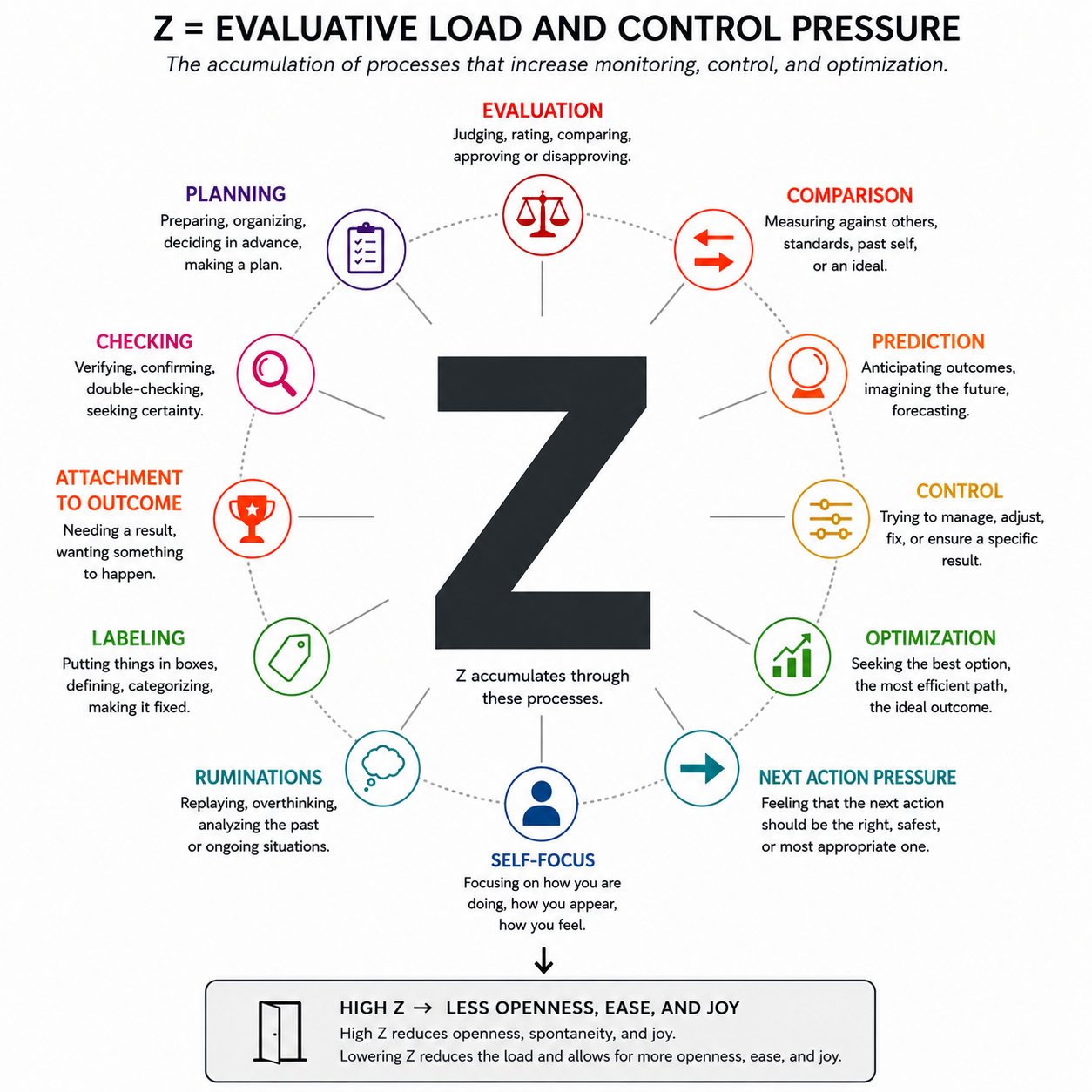
This website presents a framework in which what is commonly called joy is not rare, but is blocked by evaluative monitoring rather than produced by reward or goal-attainement.
This work is often misread as meditation, flow, happiness, or reward. It is not. Read clarification (PDF).
About · Contact · The main paper · Full Research Corpus · View the M-ZRT protocol
Independent Researcher (Affective science)
A distinct form of positive experience is blocked by evaluative monitoring, including attempts to produce or verify it.
Evaluative Monitoring, Threshold Dynamics, and Access Conditions in the Ease Regime.
All theoretical content presented here has been developed independently by the author.
I also maintain a separate research corpus on quiet exclusion at quietexclusion.org.
Childhood joy may reflect a baseline regime of experience, here termed Ease, that becomes progressively inaccessible as evaluative monitoring, correction, and optimization come to dominate cognition. The central claim is therefore not that joy disappears, but that access to it becomes structurally constrained by control processes. Z functions as a state variable that gates entry into this regime. Attempts to measure or intentionally reproduce the state recruit evaluative monitoring, thereby suppressing entry and giving rise to a measurement paradox. A related blocking mechanism, Z_shift, occurs when efforts to verify or regain the state induce sustained monitoring, preventing re-entry. When the system tries to check, produce, or confirm the state, it activates the very processes that block it. As a result, the state is easiest to enter when it is not being monitored, and hardest to re-enter once monitoring has been engaged.